
A Day of Practice
with Ajahn Amaro
Abbot of Amaravati Monastery · Ordained by Ajahn Chah in 1979 Meditation, teaching, and quiet company — offered freely, in the tradition of the forest monasteries.
There is no charge to attend. All are welcome.
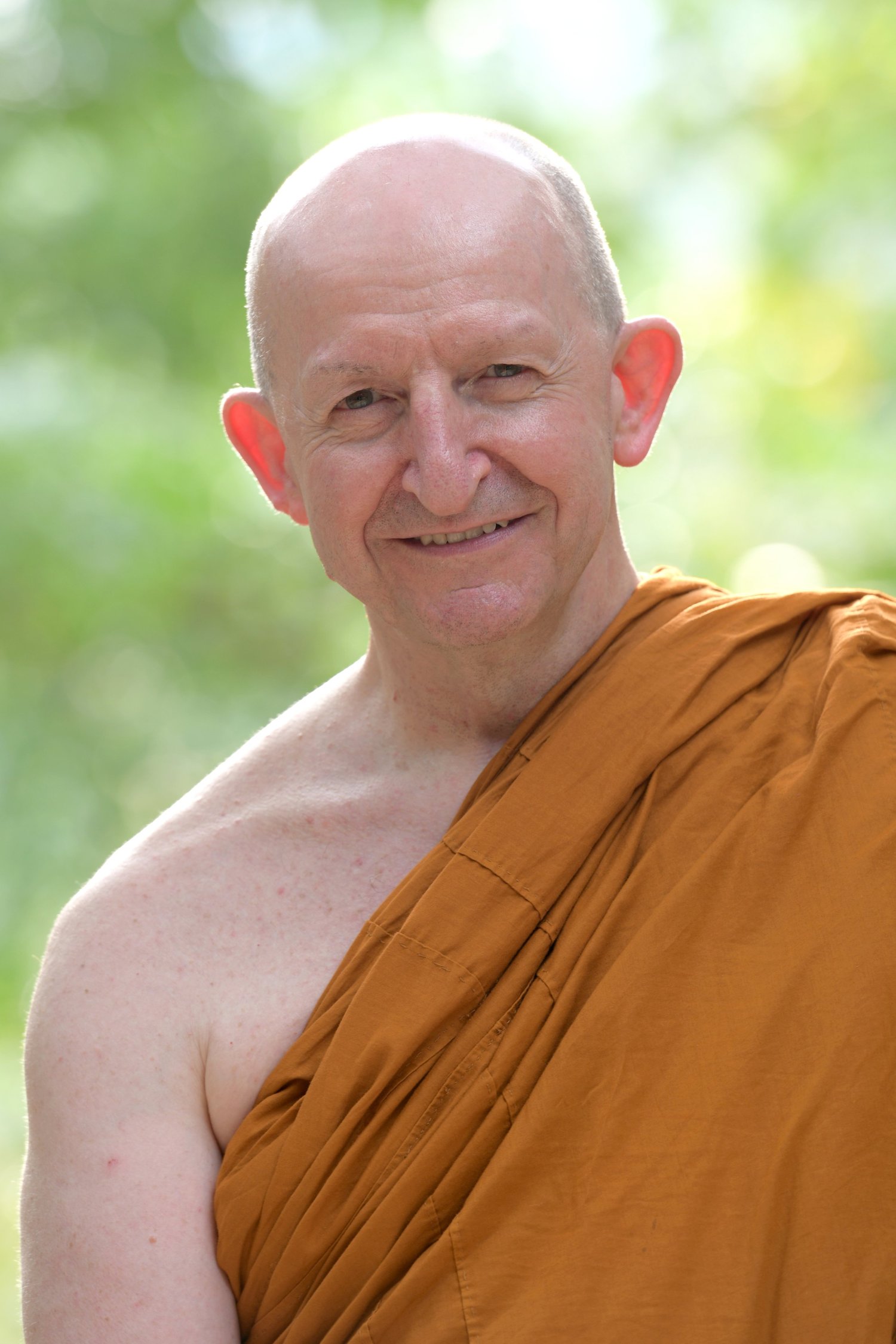
Most of us are carrying more than we let on. The days fill up, the mind gets loud, and we sense there is another way to meet all this — but knowing it and living it are different things.
For one Saturday in September, we are setting that gap down.
Ajahn Amaro is the abbot of one of the largest Buddhist monastic communities in the West. He has lived as a monk for over forty-five years.
He is coming here, to a former church on Maldon Road, to sit with whoever turns up.
There is nothing to buy and nothing to prepare. Come as you are.
Ajahn Amaro
Ajahn Amaro was born Jeremy Horner in Kent in 1956. He read Psychology and Physiology at the University of London, and in his early twenties travelled to Thailand, where he found his way to a forest monastery and did not leave.
He was ordained in 1979 by Ajahn Chah — the Thai master whose teaching brought this tradition to the West. Since 2010 he has been Abbot of Amaravati Buddhist Monastery in Hertfordshire.
He teaches without ornament: clear language, dry humour, and a refusal to make the practice sound more complicated than it is.
The 830-mile walk
In 1983, Ajahn Amaro was asked to move from Chithurst Monastery in West Sussex to a new branch monastery at Harnham, near the Scottish border.
He walked.
Eight hundred and thirty miles, the length of England, on foot and without money — in the old tradition of tudong, the wandering practice, in which a monk carries only his bowl and robes and depends entirely on whatever ordinary people choose to offer him along the way. He slept where he could and ate only what was given.
He wrote the journey down afterwards, in a book called Tudong: The Long Road North, later expanded as Silent Rain.
It is worth knowing this about him. The person coming to Colchester in September has spent his life practising the thing he teaches — including the part about depending on the kindness of strangers.
A life in the tradition — the short version
- 1956
- Born in Kent, England
- 1970s
- Reads Psychology and Physiology at the University of London
- 1978
- Travels to Thailand; arrives at Wat Pah Nanachat, the forest monastery established for Western disciples of Ajahn Chah
- 1979
- Ordained as a bhikkhu by Ajahn Chah himself
- 1979
- Returns to England to help Ajahn Sumedho establish Chithurst Monastery in West Sussex
- 1983
- Walks 830 miles from Chithurst to Harnham Vihara, Northumberland
- 1985
- Moves to the newly opened Amaravati Buddhist Monastery
- 1990s
- Begins annual teaching visits to California
- 1996
- Founds Abhayagiri Monastery in Redwood Valley, California, where he serves as co-abbot for fourteen years
- 2010
- Returns to England at the request of Ajahn Sumedho to become Abbot of Amaravati
His writing
Ajahn Amaro has written and co-written a number of books, all of them given away freely by the monastery rather than sold:
- Tudong: The Long Road North (1984)The account of the walk, later expanded as Silent Rain
- Small Boat, Great Mountain (2003)
- Rain on the Nile (2009)
- The Island: An Anthology of the Buddha's Teachings on Nibbana (2009)Written with Ajahn Pasanno
- Finding the Missing PeaceA guide to meditation
Like the teachings themselves, these are available without charge from Amaravati.
Where he is coming from — Amaravati
Amaravati sits at the eastern end of the Chiltern Hills in Hertfordshire. The name means “the deathless realm.”
It is one of the principal monasteries of the Thai Forest Tradition in the West — home to between twenty and thirty monks and nuns living a contemplative, celibate life under the same monastic rule the Buddha laid down two and a half thousand years ago.
The monastery accepts no fees for anything. Retreats, teachings, meals, accommodation — all of it is given, and all of it is funded by whatever ordinary people choose to offer. It has operated this way since 1985.
The site was bought by the English Sangha Trust in the mid-1980s. Before that it had been a residential school, built in Canadian cedar by the Canadian Air Force before the Second World War. The Sangha formally opened it as a monastery in 1985. A purpose-built temple was opened in 1999 by Princess Galyani Vadhana, sister of the King of Thailand.
The community includes monks, nuns, and anagārikas — lay postulants who wear white and commit to at least a year of training. A retreat centre within the monastery runs residential retreats for the public nine months of the year.
The tradition it belongs to traces back through Ajahn Chah, the Thai forest master who encouraged his Western students to establish monasteries in England, to a lineage of forest-dwelling monks stretching back to the Buddha's own community.
amaravati.org
Unhurried, with room to breathe
A full day, unhurried, with time built in to rest and to be quiet.
Morning meditation and a Dhamma talk. At midday the community offers lunch to Ajahn Amaro, in the traditional way, followed by a period of silence. Then lunch together, questions and answers, and a closing chant of blessings.
Please bring your own packed lunch, and any snacks you will want to keep you going through the day. Tea, coffee and hot water are provided from morning to close.
See the full timetable
Freely given
For twenty-six centuries the teaching in this tradition has been offered without charge. A monk does not sell what he has been given. Ajahn Amaro comes to Colchester as he goes everywhere — offering the teaching freely, asking nothing.
That is why there is no ticket for this day, and why there never could be.
But it also means something is being asked of us instead — not payment, but participation. In this tradition the teaching and the community that supports it are two halves of one thing. The monk gives the Dhamma. The lay community gives the conditions that make it possible: the food, the room, the journey, the hands that set out the chairs.
This is what dāna means. It is not a donation button. It is a practice, and it is the oldest one there is. We would ask you to take part in it.
The Dhamma Centre is a small charity, run almost entirely by volunteers, in a building a hundred years old. It has running costs whatever the season, and a day like this carries its own: the room, the meal we offer to Ajahn Amaro, insurance, printing, the journey from Hertfordshire and back. There is also the part nobody sees — the weeks of quiet work beforehand, done in evenings and at kitchen tables by people who are not paid for it.
What is given beyond those costs is how the Centre grows: how the building becomes a steadier, more comfortable place to practise, and how we bring the next teacher, and the one after. There are people of real depth in this tradition who would come to Essex if there were somewhere established enough to receive them properly. That is what we are trying to build, and it is built by the people in the room.
A contribution of around £30 covers one person's place for the day. Give more if you can. Give less, or nothing at all, if that is where you are. Nobody is turned away, and nobody is asked.
If you are able to give, it helps us a great deal to receive it when you register rather than on the day. Knowing roughly what we have to work with is what lets us plan properly — and spend it on making the day better for everyone who comes.
Where your giving goes
There will be two separate offerings on the day, kept entirely apart:
For Amaravati Monastery
A basket near the shrine. This goes in full to the monastery that has sent Ajahn Amaro to us, and supports the community there — which, like this day, runs on nothing but what people choose to give. Ajahn Amaro does not handle money himself; the offering is sent on afterwards.
For the Dhamma Centre
This covers the day itself — the hall, the meal we offer to Ajahn, printing, insurance, the fuel for the journey from Hertfordshire and back, and the weeks of preparation behind it. Anything beyond that goes towards improving the building for practice and bringing further teachers of this calibre to Colchester.
Offerings can be made at dhammacentre.com/donate, or in the basket on the day.
We are a registered charity, no. 1190052. If you are a UK taxpayer, Gift Aid adds 25p to every pound you give, at no cost to you. You can complete the Gift Aid form in advance, or there will be forms available on the day.
Two ways to be here
There are two ways to be part of this day. Both matter.
Places are limited by the size of our hall, so please do register — it helps us prepare properly and means we can reach you if anything changes.
Registration is free. If you register and find you cannot come, please tell us; someone else would be glad of the place.
A day like this does not appear on its own. Chairs have to be set out, tea urns filled, the hall cleaned before and after, people welcomed at the door, the meal for Ajahn prepared and offered.
In this tradition, that work is not the boring part around the edges of the event. It is the event — it is how a lay community takes care of a teacher, and it has been done this way for a very long time. Most people who help find it is the part of the day they remember.
You do not need experience, and you do not need to be a Buddhist. You need to be willing and reasonably reliable.
What volunteering involves — the jobs that need doing
Email admin@dhammacentre.com with your name and a phone number, and tell us which of these would suit you — as many as you like:
- Setting up the hall — Friday evening 18 September
- Setting up the hall — Saturday early morning
- Welcoming and registration desk
- Kitchen — preparing the meal we offer to Ajahn Amaro
- Kitchen — tea, coffee and hot water through the day
- Helping at the meal-offering ceremony
- Car parking and directing arrivals
- Clearing and cleaning after — Saturday afternoon
- Happy to go wherever I'm needed
Do also tell us about any access needs or anything else we should know.
We will be in touch before the day with what to expect and when to arrive. There will be a short briefing on the morning — you will not be dropped in unprepared.
Before you come
What to bring
A packed lunch, and any snacks you will need. There is no food provided, and the day is a long one — please bring enough to keep yourself going from morning through to three o'clock.
A water bottle. We have a reverse osmosis carbon filter at the Centre, so you can refill freely all day. Bringing your own bottle rather than using a cup saves our volunteers a great deal of washing up.
To drink, we will be offering black tea, herbal teas and black coffee, with a choice of plant-based milks and cow's milk.
A cushion or blanket if you have a favourite. Nothing else is needed.
If you would like to contribute a dish to the meal we offer to Ajahn Amaro, please tell us in advance so we can plan the meal properly — email admin@dhammacentre.com.
What to wear
Whatever you are comfortable sitting in. Modest and loose is easiest. Shoulders and knees covered is the usual convention when a monk is present, and it saves anyone feeling self-conscious.
If you are new to this
You will not be the only one. There is no chanting you must join, no posture you must hold, and no moment where anyone will single you out. Watching is a complete way to take part.
Chairs are available and entirely fine — you do not need to sit on the floor, and nobody will think anything of it if you don't.
If something is unclear, speak to one of the volunteers — there will be someone nearby all day.
A few small customs
Monastic life comes with some conventions that may be unfamiliar. None of them are tests, and nobody minds an honest mistake.
- People usually stand when a monk enters the room, and place their palms together in greeting rather than shaking hands.
- Monks do not handle money. Any offering goes into the basket, not into his hands.
- By monastic custom, items are not passed directly from a woman to a monk — they are placed on a cloth, or passed via a man. A volunteer will quietly help with this at the offering.
- Photographs are welcome at the beginning and end of the day, but not during meditation or the talk.
If you forget all of this, it will be perfectly all right.
Getting here, parking and access
Dhamma Centre, 175–181 Maldon Road, Colchester, Essex CO3 3BL
Parking
There is on-site parking for around 25 cars, free of charge. We expect this day to be fully subscribed, so those spaces will go quickly. If you live close enough to walk, please walk. If you are driving, please consider offering a lift or sharing with someone else who is coming — it is a small kindness that makes the morning much easier for everyone arriving after you.
Access
We should be honest about the building: it is a hundred-year-old former church, and we do not have an accessible toilet. If you have access needs, do please get in touch before the day at admin@dhammacentre.com and we will tell you plainly what we can and cannot manage, and do whatever we can to help.
Children
Older children who can sit quietly are very welcome, with a parent alongside them.
We should say honestly that the day is not built for younger ones. There are long stretches of stillness and silence, and it would be a hard ask of a small child — and a difficult day for the parent trying to manage it. That is a reflection of how the day is shaped, not of how we feel about children being here.
Days like this do not come to Colchester often
Whatever brings you — curiosity, exhaustion, an old interest never followed up, or nothing you can name — there will be a seat for you, and a cup of tea, and a quiet room.
We hope very much that you will come.
— The Dhamma Centre
Reserve a place