Slow movement for
a busy nervous system
An hour of gentle, structured Tai Chi. No experience needed, nothing to buy, and no one watching you. Most people arrive tense and leave noticeably calmer — that is the whole point.
If you have ever thought "I'm not really a Tai Chi person" — you are exactly who this class was designed for.
Most people who walk through our doors on a Monday are not looking for a martial art or a spiritual path. They are looking for one hour in the week where their shoulders come down from around their ears.
Maybe your GP suggested low-impact movement. Maybe your balance isn't what it was. Maybe you have tried the gym and found it made the noise in your head louder rather than quieter. Tai Chi works differently: the movements are slow enough that you have to pay attention, and paying attention is the thing that settles you.
You do not need to be flexible, fit, calm, or spiritual to start. You need an hour and something comfortable to wear.
Exactly what happens in the hour
The most common reason people don't try a class is not the price — it's not knowing what they're walking into. So here it is, start to finish.
You will not be asked to introduce yourself to the room. You will not be corrected in front of others. If you need to sit down at any point, you sit down.
-
Before we start
Arrive, park, settle
Come in, leave your bag at the side of the hall, and stand wherever you like. Arriving around 6.20pm on your first visit gives you time to get your bearings in the old church building rather than rushing in.
-
First 10 minutes
Waking the body up
Gentle standing exercises to loosen the joints and get circulation moving. Shoulders, wrists, hips, knees. Nothing strenuous, nothing on the floor, no lying down.
-
Next 15 minutes
Qi Gong — breath and energy
A short set of repeating movements paired with the breath. This is where most people first notice the shift — the internal chatter quietens because there is something simple to follow.
-
The main 25 minutes
The Yang long form
We work through the opening sequence of the traditional 108-movement form, a few postures at a time. Debra demonstrates, then walks the room. You copy. You will not get it right at first and that is genuinely fine — people spend years on this form.
-
Last 10 minutes
Closing and standing still
A quiet close, then tea and a chat for anyone who wants to stay. Plenty of people head straight off, which is also completely fine.
The things people worry about
"Will I be the only beginner?"
No. The class runs as a mixed group year-round and new people join most months. Beginners stand nearer the front where they can see clearly, which is the opposite of being on display — everyone else is watching Debra, not you.
"Will I be the oldest? The youngest?"
Our Monday group spans several decades. Tai Chi is one of the few practices where a 70-year-old and a 30-year-old work in the same room at the same pace without either being held back.
"Is this religious? It's a Dhamma Centre."
The class is not a religious practice and there is nothing to sign up to, believe, or chant. We are a charity rooted in Eastern contemplative traditions and open to everyone — the Tai Chi class is simply a movement class, taught in its own tradition.
"What if I physically can't do some of it?"
Tell Debra at the start and movements will be adapted. Much of the form can be practised at reduced range or seated. People come to this class with arthritis, fibromyalgia, recovering injuries and long-term conditions.
"I have no coordination whatsoever."
Coordination is the thing you're building, not the thing you need beforehand. Slow movement is far more forgiving than fast — there's time to notice where your foot is and move it.
"What if I hate it?"
Then you've spent £10 and an hour finding out — roughly the price of two coffees. Book a single class, come once, and if it isn't for you nobody will chase you.
Why slow movement works
Tai Chi is well studied. Research within NHS exercise referral settings has looked at what happens to people — many referred for stress, anxiety, low mood, high blood pressure and weight-related conditions — after Tai Chi sessions.
Balance and leg strength
Slow weight transfer builds the stabilising muscles that ordinary walking doesn't reach — without impact on knees or hips.
A settled nervous system
Sustained, slow, breath-linked movement supports the body's rest-and-recover state. This is why it suits people carrying long-running stress.
Focus that lasts
Following a sequence for an hour is attention training. Regular practitioners report clearer thinking and better sleep alongside the physical changes.
Tai Chi supports general wellbeing and mobility. It is not a treatment for any medical condition — if you have a health concern, please speak to your GP.
Debra Colkett
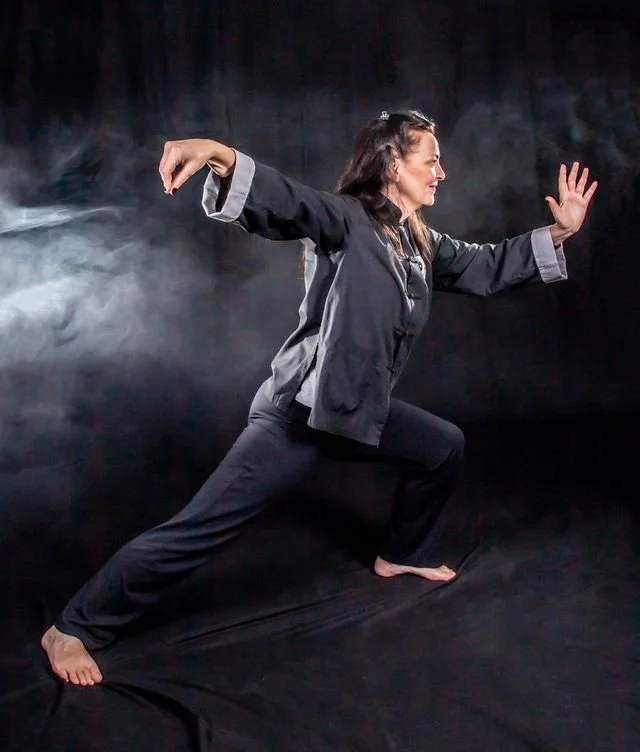
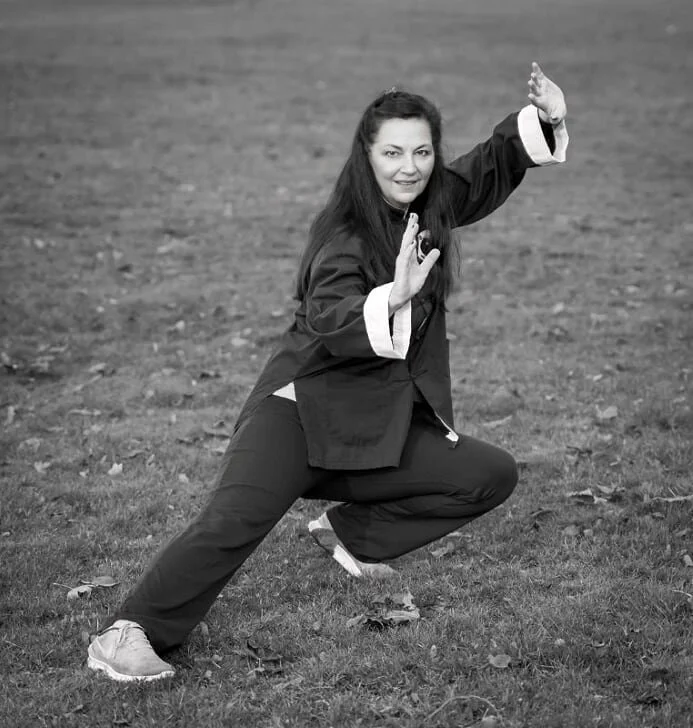
Debra has been practising and teaching Tai Chi for more than 35 years. She teaches Yeung (Yang) family Tai Chi — a tradition passed down directly from the descendants of the original Yang family, tracing back to Yang Cheng Fu, Grandmaster of Yang Tai Chi Chuan.
"Tai Chi takes a short time to learn and a lifetime to master. I'm interested in where you are today, not where you think you ought to be."
She has taught people through anxiety, low mood, fibromyalgia and post-injury recovery, and is unhurried about it — the class moves at the pace of the room. Her teaching emphasis is on alignment, breath and steadiness rather than performance.
Come once and see
No membership, no joining fee, no minimum commitment. Take one Tai Chi class, see how your body feels afterwards, and decide from there.
If you already know you want to make a habit of it, the block of six brings each class down to £8.33 and saves you re-entering your details every week.
Questions first? Email admin@dhammacentre.com — we'd rather answer them than have you not come.
Concessions available on request — just drop us a line.
All classes are booked in advance. Takes about a minute. Credit-only refunds within 7 days — see our Refunds Policy.
Before your first class
Do I need to book in advance?
What should I wear and bring?
- Loose, comfortable clothing you can move in — no special kit, no leggings required
- Flat, flexible shoes or clean indoor trainers. Socks are fine if the floor suits you
- A water bottle
- Nothing else. There are no mats, props or equipment to buy
Is this a Buddhist class?
I have a health condition or an injury
Where exactly are you, and is there parking?
How long before I notice anything?
Can I afford it if money is tight?
One hour, once a week
You don't have to decide whether you're a Tai Chi person. You just have to come once and let your body answer.
Book your first Tai Chi class